
July 2026 Company Update
Each month a more involved write up on sales market conditions, and extra information on industry trends can be found in our monthly website blog post.
Texas Lock Law Compliance
One of the basics of rental property that most landlords overlook is the Texas Lock Law. This property code required item mandates that all rental properties meet certain standards of locks for renter security. We ensure your compliance to this very liability prone area with all of our properties prior to a new resident moving into them, or upon the start of management services.
How do we ensure your compliance? Each exterior door (including the one to the garage) has a keyed lock, that can be unlocked from the outside with a key, a keyless deadbolt, a peep hole. Sliding doors have a latch, drop bar, and/or a security pin. In addition, to simplify your ongoing maintenance, we also ensure all exterior doors do not have keyed entry knobs. Why? Because we’ve found that these keyed knobs add another lock to rekey and tenants are notorious for bumping them, and engaging the lock. Accidently locking themselves out of the home!
In addition, we have all this work completed prior to move in. That way when a new resident is moving in, they already have brand new keys and don’t have to schedule with a locksmith for a streamlined move in experience.
Sales Market Trends with Mike Minns
Austin’s housing market is moving into the second half of the year with more balance than the pandemic-era market, but the data varies depending on whether you are looking at the City of Austin, the broader Austin-Round Rock-San Marcos metro, or all Austin-area MLS activity. Inventory remains elevated compared with recent years; homes are generally taking longer to sell than during the peak market, and price trends are mixed across sources and property types.
Numbers to Watch
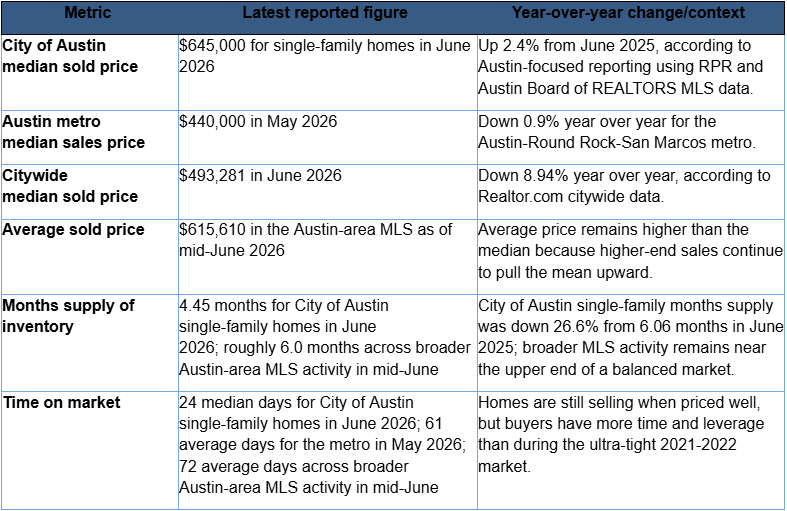
What the Numbers Mean Locally
For sellers, overpricing is now riskier due to higher inventory levels and longer time on the market, prompting buyers to compare options more thoroughly. Homes starting at too high a price are more prone to price cuts. Conversely, buyers have more room to negotiate than during the market' peak years, but well-located, desirable homes can still sell swiftly when priced appropriately. In summary? It's still a buyer's market.
Iran War, Mortgage Rates, and Inflation
The conflict in Iran has mainly influenced mortgage rates through changes in oil prices and inflation outlooks. Interruptions in Middle Eastern oil and refined product exports have increased energy costs. The Federal Reserve Bank of Dallas projected that this oil supply situation could raise the fourth-quarter-over-fourth-quarter headline PCE inflation by approximately 0.6 percentage points and boost core PCE inflation by about 0.2 percentage points in 2026. When investors anticipate sustained higher inflation, long-term Treasury yields tend to stay high, which can also keep 30-year fixed mortgage rates elevated.
For Austin buyers, the practical impact is affordability. Even modest increases in mortgage rates can affect monthly payments and debt-to-income ratios, especially at Austin price points. This is one reason some buyers remain cautious despite increased
inventory and softer pricing in parts of the market.
Jobs Report and Federal Reserve Outlook
The latest labor-market reports point to slower hiring. June payroll growth was reported at only about 57,000 jobs, with the unemployment rate near 4.2%. A cooler labor market usually reduces pressure on the Federal Reserve to raise rates because additional tightening could risk further slowing the economy.
That said, inflation remains the key constraint. The Federal Reserve’s June projections showed higher inflation expectations than earlier in the year, with core PCE inflation revised upward for 2026. In plain English: weaker job growth makes rate hikes less likely, but the Iran-related energy shock and sticky inflation make near-term rate cuts harder to justify. The most likely near-term path is a data-dependent Fed that stays cautious rather than aggressively raising rates.
Buyer and Seller Takeaways
- Buyers: More inventory and longer time on market can create opportunities for negotiation, especially for homes that have been listed for several weeks or have already reduced their price.
- Sellers: Pricing strategy matters more than ever. Homes that are clean, well-prepared, and priced to current comparable sales are still getting attention. If you don’t need to sell, I recommend waiting another 1-3 years.
- Move-up buyers: The trade-off is more choice on the purchase side, but mortgage-rate sensitivity can affect both buying power and the buyer pool for your current home.
- Investors: Currently, its challenging to purchase anything other than duplexes and still achieve positive cash flow. We have identified duplexes for clients at prices below their peak, which do generate cash flow.
Bottom Line
Austin's market varies across segments—some are balanced, others favor sellers or empower buyers. The overall economy is mixed: inflation and mortgage rates rise due to the Iran conflict, yet slower job growth decreases the likelihood of aggressive rate hikes by the Federal Reserve. I advise caution in selling now but see potential in buying properties below the peak and from motivated sellers.
How Are We Doing?
As we work through the peak of our busy season this year, I’d love if you could take a moment and let us know how we’re doing on our website here. What’s working best for you, what isn’t, and anywhere we could improve. We’re always looking for ways to improve our services, and bring in additional benefits and services.
I appreciate your continued trust and business.
Christopher M. Francis // Owner
Rollingwood Management, Inc.